
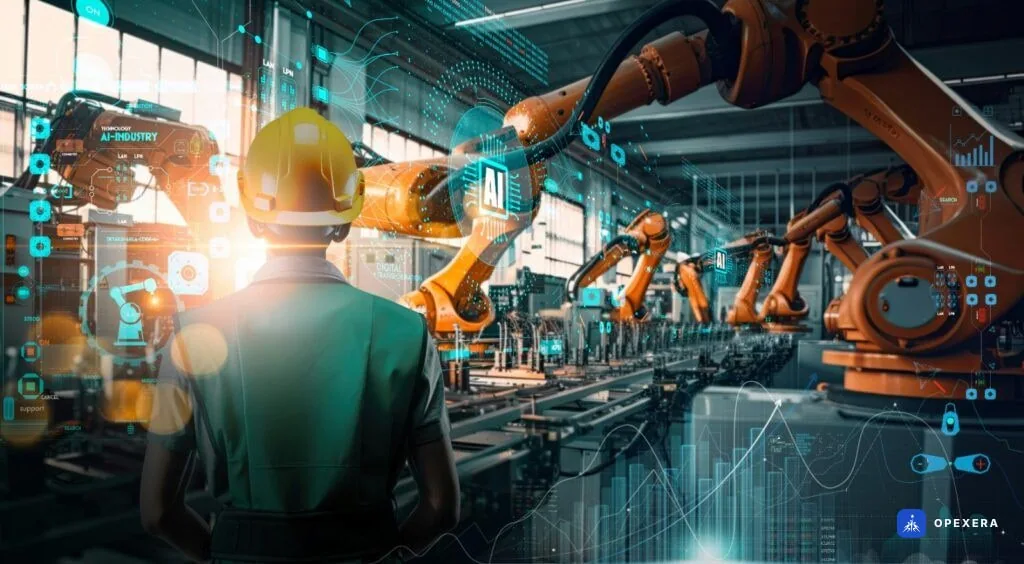
Ever since the industrial revolution, factories have been associated with light, human labour and shift work. Today, though, the manufacturing world stands on the edge of an entirely different transformation: dark factories. With no lights on, no shifts and machines and artificial intelligence producing around the clock, these plants already show us the industrial standards of the future.
In this article I look at dark factories brought to life in different corners of the world, from Philips Drachten in the Netherlands to Siemens Amberg in Germany and the Xiaomi and Gree examples in China. They all converge on one point: the factories of the future shine in the dark.
What Is a Dark Factory?
A dark factory is a plant in which no human works in the production process, and which is run entirely by automation, robotic systems and artificial intelligence.
- Production lines are run by robots.
- Material flow is handled by AGVs (Automated Guided Vehicles) or AMRs (Autonomous Mobile Robots).
- Quality control is performed automatically by machine vision systems.
- The plant's entire operation is managed through a central artificial intelligence / MES (Manufacturing Execution System).
As a result there is no need for lighting, heating/cooling or conventional ergonomic arrangements: production continues even with the “lights out”.
The Dark Factory: A Historical Development
| Year / Period | Development | Description |
| 1970s | The first ideas | As automation gathered pace in Japan and the United States, the idea of the “unmanned factory” began to appear in the literature. |
| 1980s – 1990s | Pilot applications in electronics & automotive | Automotive giants and electronics manufacturers raised robot density on their assembly lines and had their first dark factory experiences. Full automation was not possible, however, because the technology was limited. Fanuc led the first applications in this area. |
| 2000s | Digitalisation & robotics advance | Sensors, industrial robots and production software matured. The dark factory concept stopped being theoretical and became more achievable. |
| 2011 | The launch of Industry 4.0 (Germany, Hannover Fair) | The Industry 4.0 vision introduced under the leadership of Kagermann, Wahlster and Lukas brought the smart factory concept to the fore. The dark factory was redefined as the extreme case of that vision. |
| 2015 – 2020 | Pilot projects | “Lights-out” factories were brought into service in the automotive, electronics and semiconductor sectors in China, Germany, the United States and the Netherlands (e.g. Philips Drachten, Siemens Amberg). |
| After 2020 | Examples of fully automated plants |
– Xiaomi Smart Factory (China, 2021): a plant built with a $330 million investment, aiming to make smartphone production unmanned. |
| Today (2025) | Hybrid & fully automated factories | Fully unmanned dark factories are still rare; but hybrid models (human + robot collaboration) are spreading. Industry 4.0 infrastructure (IoT, artificial intelligence, digital twins, machine vision) is turning this vision into reality. |

“What all of us need to do is make sure we are using artificial intelligence in a way that benefits humanity, not in a way that harms it.”
Tim Cook
Examples of Dark Factories
Xiaomi
Xiaomi's Changping Smart Factory: A Dark Factory Running 24/7
In 2023 Xiaomi drew worldwide attention with the smart manufacturing plant it opened in Beijing's Changping district. Covering roughly 81,000 square metres — the equivalent of 11 football pitches — the factory stands out for its fully automated “dark factory” concept.
No Lights. No Breaks. No Shifts.
In Xiaomi's own words, there is not a single person on the floor of this plant. Production runs 24/7 without interruption. There are no shift changes, meal breaks or rest periods; robots and AI systems can produce without pause.
Capacity and Production Targets
-
Production capacity: over 1 million smartphones a year
-
Line design: a fully automated assembly line
-
Product focus: it serves as a pilot production line for Xiaomi's next-generation devices, smartphones above all.
Technology: the Hyper Intelligent Manufacturing Platform (HyperIMP)
At the heart of the factory sits Xiaomi's own Hyper Intelligent Manufacturing Platform (HyperIMP). Through this platform:
-
Production processes are optimised in real time with artificial intelligence.
- Machine vision (image processing) performs quality control automatically on the line.
-
Predictive maintenance algorithms identify the risk of failure in advance.
-
Data-driven decision making continuously improves production planning and resource use.
The Xiaomi Dark Factory Experience
-
Working environment: The term “dark factory” means the lights are off and no human presence is required. In reality people do step in for maintenance, software control and supply processes, but the assembly line stage runs 100% automatically.
-
Efficiency: Fewer errors from the human factor, higher speed and round-the-clock production all deliver a cost advantage.
-
Flexibility: The system can be reprogrammed in software so that different models can be produced on the same line.
Xiaomi's Vision
With this factory Xiaomi aims not only to raise its own production capacity but also to contribute to China's smart manufacturing vision. The Changping plant is held up as one of the most striking examples of the “dark factory” trend in China.
Xiaomi's Changping factory is a showcase for the production model of the future. A model in which human labour disappears entirely has not yet spread to every process, but this plant is a powerful indicator of how far automation has come. A world of production without lights and without shifts is no longer science fiction; Xiaomi has put it into practice on the floor.
Gree
Gree's 5.5G-Based Dark Factory: The Largest Example in the World
One of the most striking examples of the dark factory concept is Gree Electric Appliances' Gaolan Smart Manufacturing Factory in Zhuhai, China.
The World's Largest 5.5G Native Lights-out Factory
Gree and China Unicom With this plant, developed in partnership, it took the title of “the world's largest 5.5G-based dark factory”. The factory was built from the ground up on a 5.5G native private network. That makes low latency, high bandwidth and real-time data transfer possible throughout the production processes.
Capacity and Efficiency
- Annual production capacity: ~12 million split air conditioners
- Efficiency: around 86% higher than conventional factories
- Workforce profile: there are no people on the line's main processes, only a small number of staff for maintenance, quality control and inspection.
Technology and Innovations
- Digital twin: the 80,000 m² warehouse area was designed with a digital twin and is run by AGVs/AMRs.
- 5.5G integration: thanks to RedCap terminals and IoT devices, production, quality control and logistics processes all run integrated over a single network.
- Real-time quality control: smart sensors and high bandwidth deliver defect-free, traceable production.
Global Recognition
- The factory won the GSMA GLOMO Awards 2025 Best Private Network Solution award.
- It was approved as a “national smart manufacturing demonstration factory” by China's Ministry of Industry and Information Technology.
Gree's Vision
Gree's Gaolan factory demonstrates not only how far automation has come but also the transformative effect of 5.5G on industry . Fully unmanned production is still an ideal rather than a reality, but with limited human support for maintenance and quality this plant has become the world's largest example of the “dark factory” concept.
Philips
In Drachten in the Netherlands, Philips operates a partly lights-out factory producing electric shavers. At this plant 128 robots handle the bulk of the assembly work, while just nine employees manage the quality assurance processes.
The production system is highly modular: thanks to flexible robot cells and vision systems, the plant can switch quickly between different shaver models. That flexibility lets the factory keep its competitive edge in markets where consumer preferences change fast.
Siemens
Siemens' Amberg factory is one of the leading examples of AI-supported production. More than 75% of the production process is automated and human intervention is minimal. The plant produces PLCs, one of the fundamental building blocks of automation worldwide.
Thanks to AI-supported production the plant achieves a product quality rate of an impressive 99.99885%. AI algorithms monitor the assembly line continuously to ensure every unit is produced with the highest precision. The “dark factory” concept at Amberg reflects a combination of high efficiency, reduced downtime and exceptional product quality.
Advantages of the Dark Factory
- Uninterrupted production: runs 24/7, with no concept of shifts.
- Cost savings: lowers labour costs and delivers energy efficiency.
- Quality: removes human error and delivers standardisation.
- Traceability: because all data is recorded digitally, retrospective analysis is easy.
- Flexibility: AI-supported systems can adapt quickly to new products.
Challenges of the Dark Factory
- High investment cost: robots, sensors, software and integration require serious up-front investment.
- Cyber security risks: having every system digital creates exposure to attack.
- Employment concerns: the role of the human workforce changes; the shift is from blue collar to data analyst and robot maintenance specialist.
- Limits to flexibility: some specialised assembly work requiring manual dexterity may still need people.
Where Does the Human Factor Go?
The dark factory does not shut people out entirely; it simply moves them off the production line and into management, planning and maintenance roles.
- Robot technicians
- Data analysts
- AI operators
- Digital twin engineers
This shift means employees move towards higher value-adding work .
Conclusion: The Factories of the Future Shine in the Dark
The dark factory concept is not just a production model with the lights switched off; it means a transformation in which human intervention is minimised, smart systems and robots run without interruption, and efficiency, quality and sustainability are redefined.
This journey — from Philips Drachten to Siemens Amberg, from Xiaomi's smart plant in Changping to Gree's vast 5.5G-based factory — shows us one thing: the future of industry lies in the combination of automation, artificial intelligence and digital network technologies.
Even though people are still needed for maintenance, quality control and strategic decision points, the role of machines and algorithms is growing fast across most of production. This change matters not only for cost advantage and speed but also for environmental sustainability, energy efficiency and global competitiveness.
Through bold steps taken today, dark factories are becoming tomorrow's standard. Before long, production areas “with the lights off” may be an ordinary part not just of industry but of daily life.
Frequently Asked Questions
1. What exactly is a dark factory and what technologies does it run on?
A dark factory is a plant in which no human takes part in the production process and which is run entirely by automation, robotic systems and artificial intelligence. These plants need no lighting, heating or cooling, because production can continue even with the “lights out”. Its core technologies include production lines run by robots , AGVs (Automated Guided Vehicles) or AMRs (Autonomous Mobile Robots) handling material flow , machine vision systems performing quality control and a central artificial intelligence or MES (Manufacturing Execution System) running the whole operation.
2. What are the most important advantages of dark factories?
The main advantages of dark factories are these:
- Uninterrupted production: They can run 24/7 with no concept of shifts.
- Cost savings: They lower labour costs significantly and deliver energy efficiency.
- High quality: By removing human error they bring standardisation to production.
- Flexibility: Thanks to AI-supported systems they can adapt quickly to producing new products.
- Traceability: Because all production data is recorded digitally, retrospective analysis becomes easy.
3. Are there challenges or disadvantages to building a dark factory?
Yes, building a dark factory comes with some significant challenges. Chief among them is the high up-front investment needed for technologies such as robots, sensors and software. Having all systems connected to digital networks creates exposure to cyber security attacks. In addition, certain specialised assembly tasks requiring manual dexterity may still need people, which sets the limit on full automation's flexibility.
4. Does the human factor disappear entirely in these factories? What will people's new role be?
No, dark factories do not shut people out of the production process entirely; they simply change their role. The workforce shifts from the production line itself to higher value-adding areas such as management, planning, maintenance and inspection. This transformation will create demand for new specialisms such as robot technicians , data analysts , AI operators and digital twin engineers .
5. Which concrete dark factory examples does the article give?
The article presents several important dark factory examples from around the world:
- Xiaomi (China): The smartphone factory in Beijing operates with the goal of unmanned production 24/7.
- Gree (China): This plant in Zhuhai is known as the world's largest 5.5G-based dark factory and has a capacity of 12 million air conditioners a year.
- Philips (Netherlands): At this plant in Drachten, 128 robots produce electric shavers while just nine employees manage the quality assurance processes.
- Siemens (Germany): At the Amberg factory more than 75% of production is automated and a product quality rate as high as 99.99885% is achieved.