
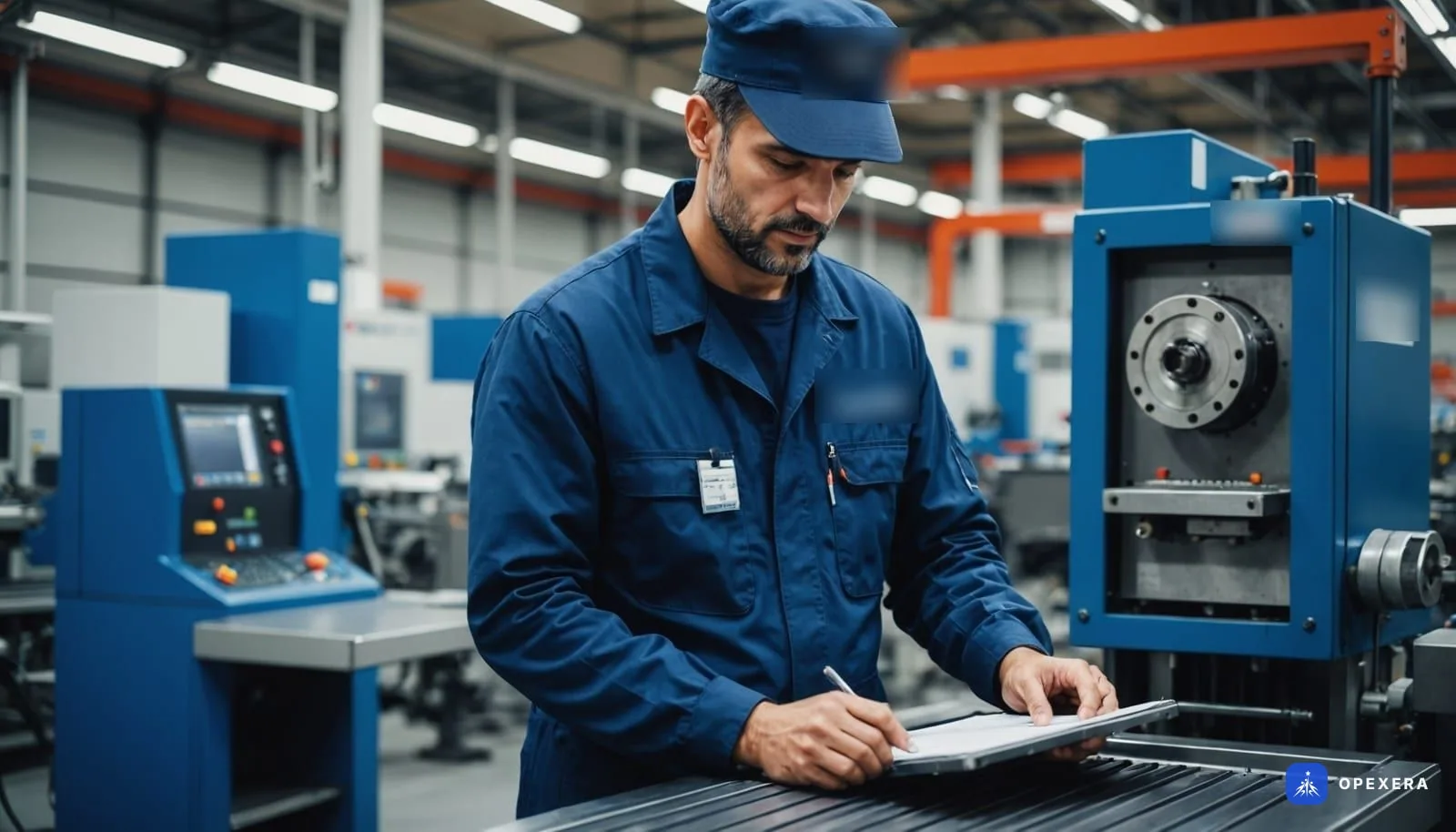
The split of "I run it, you fix it" is the most expensive wall between production and maintenance. Autonomous maintenance does not propose removing that wall but moving it to the right place: simple, repetitive maintenance work goes to the person who knows the machine best, and complex work to the specialist.
What is autonomous maintenance?
Autonomous maintenance (Jishu Hozen) is the operator of a machine taking on responsibility for cleaning, inspection, lubrication and simple abnormality detection. It is one of the eight pillars of TPM and usually the first one started.
Its purpose is not to load work onto the operator. Most breakdowns are not sudden; they give early signals such as a loosening bolt, a weeping seal or rising vibration. The person best placed to notice those signals earliest is the operator who stands at the machine for eight hours. Autonomous maintenance makes that awareness systematic.
As a result the maintenance team is freed from simple interventions and can spend its time on high-value work such as predictive maintenance, overhaul planning and root cause analysis.
The 7 steps of Jishu Hozen
1. Initial cleaning
The machine is cleaned from top to bottom. The real aim here is not cleaning but inspection: once the dirt is gone, cracks, leaks, loose fasteners and wear become visible. Abnormalities found during the initial cleaning are tagged (usually in two colours: those the operator can resolve, and those maintenance must).
2. Eliminate contamination sources and hard-to-reach areas
In the second step the question changes to: "Why is it getting dirty?" Sources such as swarf spatter, oil leaks and dust ingress are prevented; lubrication points that cannot be reached are made accessible with an extension hose or a redesigned cover. Skip this step and the cleaning standard will never hold.
3. Write provisional standards
A one-page standard is prepared for cleaning, lubrication and tightening tasks, answering: what, how often, in how long, and by whom. The times must be realistic; a 20-minute daily checklist will not get done in a shift.
4. General inspection training
Operators are given basic training on the machine's systems (hydraulics, pneumatics, electrics, drives). The aim is to be able to tell "normal" from "abnormal". One-point lessons (OPL) work very well at this stage: one page, one topic, mostly visual.
5. Autonomous inspection
The operator applies the checklist independently; the maintenance team plays a supporting role rather than a supervisory one. The abnormalities found are logged and their closure time tracked.
6. Standardisation and visual management
Inspection points are marked on the machine itself: a min-max band for the oil level, a green operating range on the pressure gauge, an alignment line on bolts, direction arrows. Inspection then becomes a matter of looking rather than reading, and takes seconds.
7. Full autonomous management
In the final step the team sets its own targets, tracks its own losses and generates its own improvement proposals. At this point autonomous maintenance has stopped being a program and become a way of working.
The difference between autonomous and planned maintenance
- Autonomous maintenance: done by the operator · daily/weekly · cleaning, inspection, lubrication, tightening · aim: early detection
- Planned maintenance: done by the maintenance team · to a schedule or by condition · part replacement, overhaul, calibration, predictive measurement · aim: intervening before failure
The two are not alternatives. Without autonomous maintenance, planned maintenance drowns in constant emergencies; without planned maintenance, autonomous maintenance cannot close out the abnormalities it finds. TPM program builds these two pillars together.
Why is 5S a precondition?
On a shop floor where sorting and setting in order have not been done, a cleaning standard will not hold: unnecessary material traps dirt, tools have to be hunted down, inspection points cannot be reached. That is why autonomous maintenance is in practice started alongside 5S — 5S prepares the area, autonomous maintenance the equipment.
Measurement: how do you know it is working?
The effect of autonomous maintenance shows up in three indicators:
- MTBF (mean time between failures) rises
- Unplanned downtime falls, and with it the OEE availability component improves
- Tag closure rate: how many of the abnormalities found have been closed out
The third is the most neglected. If operators report abnormalities but tags never close, the system stalls within a few months — because people learn that reporting leads nowhere.
Common difficulties in practice
- Not setting aside the time. If the checklist is not in the shift plan, it does not get done. Five to ten minutes a day must be formally scheduled.
- Rolling out before picking a model machine. Completing the seven steps on one model machine, rather than starting everywhere at once, makes everything afterwards much faster.
- Leaving the maintenance team outside it. Training and tag closure run on maintenance's support; without it, a sense of "they are dumping their job on us" takes hold.
- Not sharing the results. If before/after photos and downtime charts are not visible on the board, motivation drops. This is where a Kaizen board and short daily meetings are the most practical solution.