
The list of lean manufacturing tools is long, and that length often leads to false starts: a tool gets picked, and then a problem is sought to fit it. It should be the other way round. In this article we look first at the types of waste, then at the tool that answers each one.
The 8 wastes in lean manufacturing
In lean thinking, waste (muda) is any activity the customer is not willing to pay for. The Toyota Production System defines seven wastes; the eighth was added later.
- Overproduction. Producing more than needed, or earlier than needed. It is the most dangerous of them because it triggers the other seven: it creates inventory, hides defects and consumes space and cash.
- Waiting. An operator waiting for material, instructions, approval or a machine.
- Unnecessary transport. Moving the product between stations without need. Every move is a risk of damage and lost time.
- Over-processing. Precision the customer never asked for, extra inspection, duplicated record-keeping.
- Inventory. Excess raw material, work in progress and finished goods. The most common blanket for hiding problems.
- Unnecessary motion. Reaching, bending, searching and walking on the part of the employee.
- Defects. Scrap and rework; the loss of material, capacity and time all at once.
- Unused employee potential. Knowledge and ideas on the shop floor that never make it into the system.
Which technique for which waste?
5S — unnecessary motion and searching
Consists of the sort, set in order, shine, standardise and sustain steps. It removes the time spent hunting for material and tools, and makes abnormality visible. It is the ground the other tools are built on, which is why 5S is usually the first technique applied.
Standard work — variability
Writing down the best known way of doing a job, together with its time, sequence and stock levels. It is the precondition for improvement: without a standard, there is no way to measure whether an improvement worked.
Kanban — overproduction and inventory
A signalling system that pulls production according to consumption rather than pushing it according to a forecast. It runs on cards, bins or electronic signals. The upstream station does not produce until the downstream one consumes; the inventory ceiling is physically capped.
SMED — waiting and large batches
By shortening changeover time it makes small-batch production economic. As long as changeover stays long, efforts to reduce inventory will not last.
Poka-yoke — defects
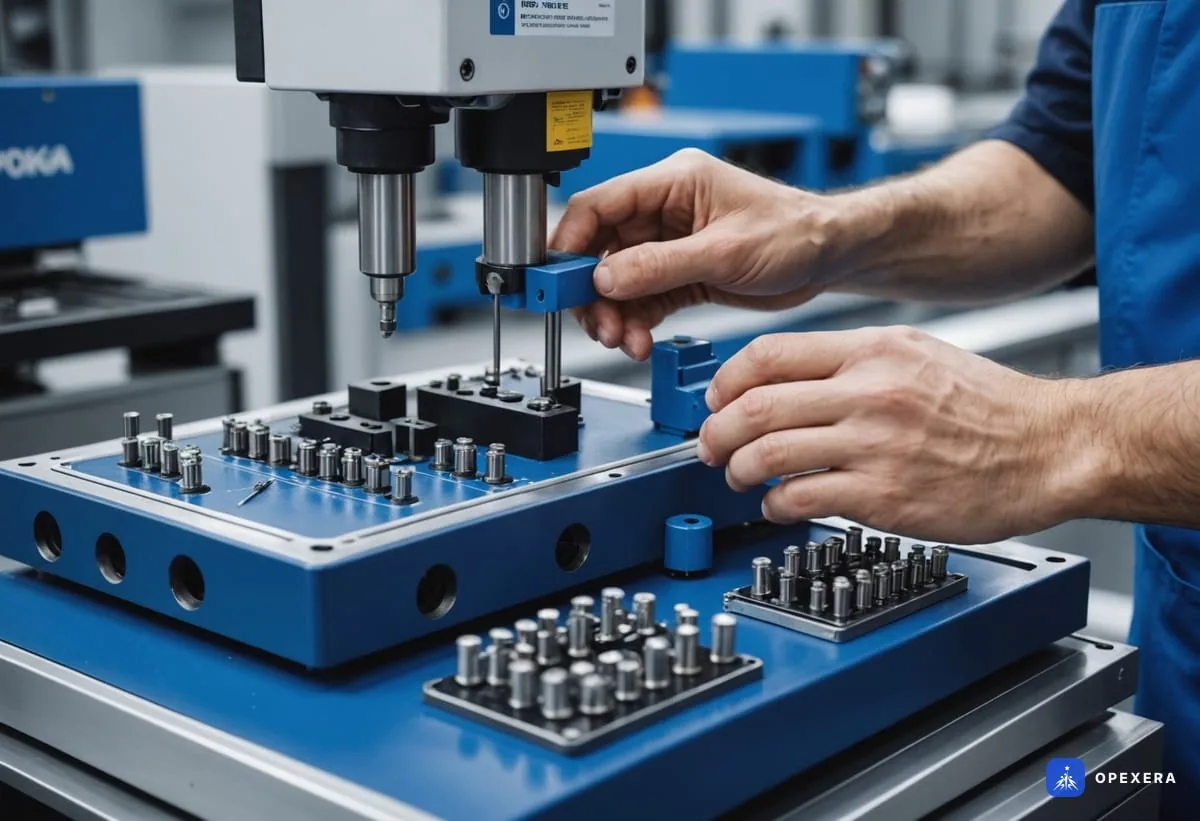
Simple mechanisms that prevent a defect before it happens. Examples from the shop floor:
- Connector and pin arrangements that can only be fitted one way round
- Pick-to-light rack systems that lock the next step until the part has been taken
- Screwdriving machines that will not complete the cycle unless the correct torque is applied
- Assembly fixtures that sense a missing part and stop the line
- Filling-line scales that detect short fills by checking weight
The power of poka-yoke lies in making the wrong action physically impossible rather than demanding constant vigilance from the operator. This approach is also the foundation of human error management.
Jidoka — the spread of defects
The machine stopping itself when an abnormality occurs and making the condition visible (andon). Defective product is then not carried to the next stations and the problem is addressed the moment it arises.
Heijunka — demand fluctuation
Levelling production over time by both type and quantity. Fluctuating production forces you to size capacity for the peak; levelling brings that cost down.
Value stream mapping — the flow as a whole
It determines where to intervene. The other tools make point improvements; value stream mapping tells you which point to choose.
Kaizen — continuous improvement
A system of small, frequent, participative improvements. It is the management style that ties all the other techniques together, and the direct answer to the eighth waste (unused employee potential).
The right order: where to start?
The sequence that works on the shop floor is usually this:
- 5S and standard work lay the ground. No measurement is reliable in a disorderly, variable process.
- Value stream mapping identifies the constraint in the flow and the biggest source of waiting.
- Choose the tool that fits the constraint: SMED if changeover is long, poka-yoke and jidoka if the defect rate is high, kanban if inventory is high, yamazumi if workload is unbalanced.
- Measure and standardise. Verify the gain against OEE and lead time, and turn the new method into a work instruction.
- Establish a Kaizen rhythm. Take on the next loss through short weekly meetings.
A system, not a tool
Applied one by one, lean manufacturing techniques deliver local gains; but lasting results only emerge when they are tied together within a management system. Kaizen will not hold without a standard, a standard cannot be verified without measurement, and measurement is not followed without a daily management rhythm.
That coherence is the link that connects lean manufacturing practices to an operational excellence approach: the tools live on the shop floor, the system at the management level. Unless both are built together, improvements revert within a few months. How to build a continuous improvement culture is a subject of its own, and it starts with Kaizen and the design of a suggestion system.