
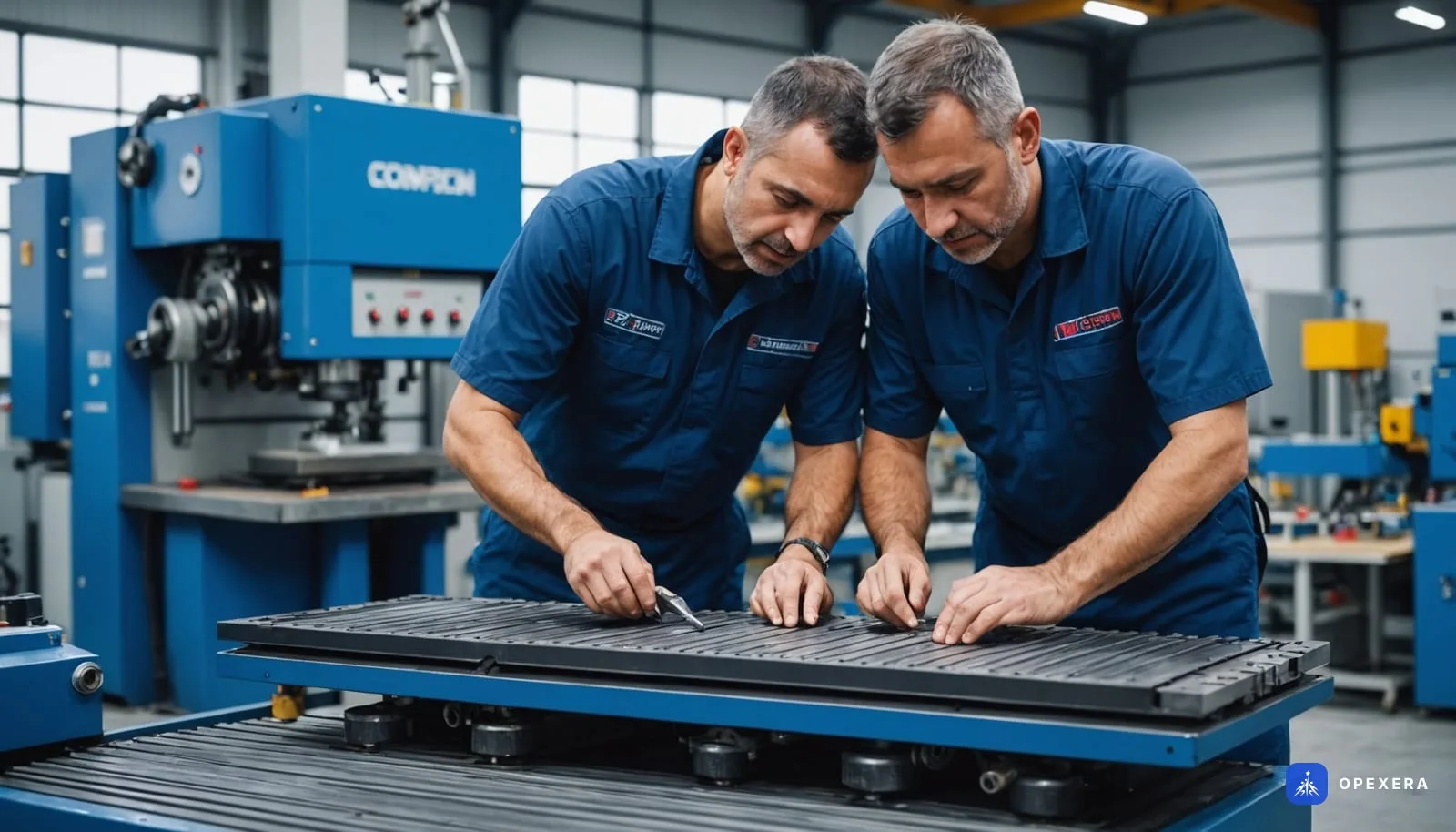
If a die change on a press takes 90 minutes, then a press that switches products twice a shift is not producing for three hours. In most plants that time is written off as "the nature of the machine". SMED is the method that shows it is not a law of nature but a solvable engineering problem.
What is SMED?
SMED (Single Minute Exchange of Die) is a lean manufacturing method aimed at cutting the product changeover time on a machine down to single-digit minutes. It was developed by Shigeo Shingo at Toyota from the 1950s onwards.
The essence of the method comes down to a single distinction: work that must be done while the machine is stopped and work that can also be done while the machine is running are separated from each other. When you measure on the floor, you find that a large share of the time recorded as "changeover" is actually preparation, searching and transport — work that never required the machine to stop at all.
Why it matters: small batches and inventory
A long changeover is not just lost capacity; it also shapes the production plan. If changing over is expensive, the business increases batch size in order to change over less often. And large batches mean inventory, floor space, tied-up cash and a wider blast radius when defects occur.
That makes SMED a lever that acts directly on flexibility: once a changeover drops from 90 minutes to 20, producing more product variants a day on the same line becomes economic. Demand swings are answered with speed rather than with stock.
The 4 steps of SMED
1. Measure the current state
Record the changeover from start to finish on video. Video is preferable to a stopwatch, because the waiting and walking time you miss on the first viewing becomes visible later. Then list every operation one by one and write down its duration.
The picture that emerges at this stage is usually the same: of a 90-minute changeover, roughly 25 minutes go on searching for tools, bolts or paperwork; 15 minutes on moving the die and waiting; and only 30-35 minutes on the actual clamping and adjustment work.
2. Separate internal and external operations
Sort every operation on the list into one of two groups:
- Internal operation: can only be done while the machine is stopped (removing the die, mounting the new one).
- External operation: can also be done while the machine is running (bringing the die over, preparing the tools, preheating, paperwork).
This step requires no investment at all and on its own usually recovers a quarter of the time. All you do is stop performing external work while the machine is stopped.
3. Convert internal operations into external ones
Now comes the demanding question: "Can I turn this internal operation into an external one?" Typical solutions:
- Heating the die at a preheating station away from the machine
- Standard clamping plates with the settings already made
- Bringing the die up next to the machine ready on a spare die carrier
- Marking the measurement and setting values on the die itself, removing trial and error
4. Simplify and standardise what remains
In the final step the remaining internal operations are speeded up: quick-clamping elements instead of bolts, U-slots that tighten in a single turn, colour-coded tools, and a split of tasks that lets two people work in parallel. The new method is then written up as a standard work instruction — otherwise the old habit returns within a few weeks.
An example from the shop floor
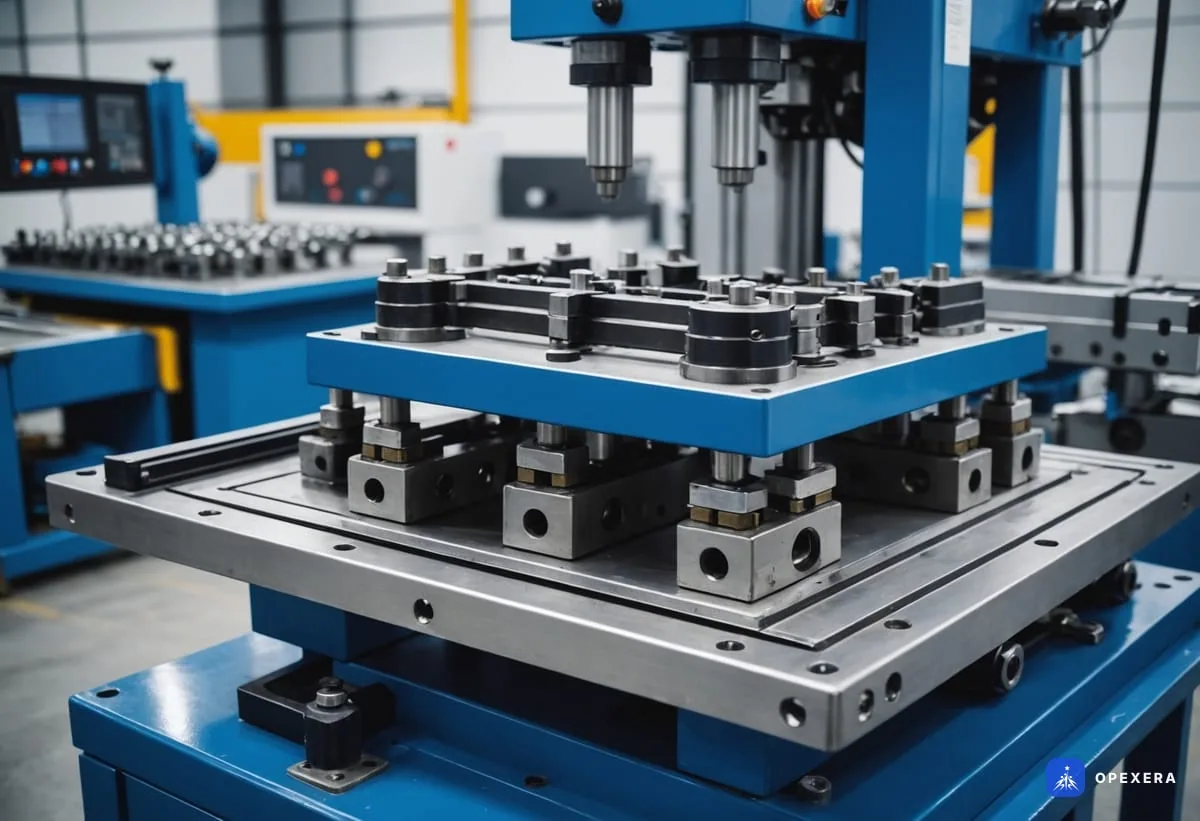
At a metal forming plant, the measured changeover time on a 500-tonne press was 84 minutes. After video analysis:
- Bringing the die over by forklift and preparing the tool trolley were moved to external work: −19 minutes
- Eight different bolt sizes were standardised down to one: −11 minutes
- A fixed spacer was used to set stroke and die height, cutting trial presses from six to one: −14 minutes
- The changeover was run in parallel with a standard two-person split of tasks: −13 minutes
The result: from 84 minutes to 27. None of the first three items required any investment in machinery. Gains of this kind show up directly in the availability component of OEE .
Common mistakes in SMED work
- Starting to improve before measuring. Estimates made without a video recording almost always point to the wrong place as the biggest loss.
- Just buying equipment. A quick-clamping system is useful, but equipment bought before the organisation is fixed will not deliver the expected gain.
- Leaving the operator out of the process. If the person who performs the changeover is not part of designing the solution, the new standard will not be followed.
- Not writing down the standard. If an improvement never becomes an instruction and a piece of training, the gain erodes within a few months. This is where the Kaizen cycle and before/after verification come in.
Where should you start?
Rather than rolling SMED out across the whole plant at once, a pilot on a single bottleneck machine delivers results faster. The most practical route is to identify the real constraint in the flow with value stream mapping and then complete a full SMED round on that machine.
The methods and standards you end up with then transfer to the next machines as a template; the second application usually takes half as long as the first. That is also where this approach sits within a lean manufacturing program as a whole: start with a fast, visible and repeatable gain.